
Duct Sizing and HVAC Replacement Cost
Duct sizing has a direct effect on overall HVAC replacement cost because undersized or crushed ductwork forces air handlers to operate under excessive external static pressure (>0.8 in. w.g.), burning out ECM blower motors prematurely and triggering high-limit safety cutoffs. If you are replacing an entire HVAC system with Anaheim Air Conditioning Pros, our CSLB certified technicians perform complete static pressure audits to ensure your existing ducts can handle higher SEER2 airflow.
To estimate your total project investment including equipment, permits, and optional ductwork modifications, use our sister tool: the HVAC Replacement Cost Calculator.
Understanding CFM and Air Velocity
CFM (cubic feet per minute) measures the volumetric flow rate of air passing through a duct. Air velocity (measured in feet per minute or FPM) describes how fast that air is moving. The mathematical relationship is: $\text{CFM} = \text{Area (sq ft)} \times \text{Velocity (FPM)}$.
Maintaining proper velocity is the difference between whisper-quiet comfort and a roaring wind tunnel:
- 600–700 FPM: Recommended for residential branch runs, sleeping quarters, and sound-sensitive spaces.
- 700–900 FPM: Standard design target for residential main supply trunks and commercial branch runs.
- Above 1,000 FPM: High risk of turbulent rumble, register whistle, and increased duct friction loss.
If you still need to calculate room-by-room CFM requirements from square footage and ceiling height first, visit our CFM / Airflow Calculator.
Round vs. Rectangular Duct Sizing
Round rigid sheet metal ducts represent the gold standard for HVAC fluid dynamics. Circular pipes provide the maximum cross-sectional area with the minimum wetted surface perimeter, resulting in 15% to 25% lower friction resistance than rectangular ducts carrying identical airflow.
However, rectangular ductwork is essential when navigating height-restricted spaces like 2×10 floor joist bays and dropped hallway soffits. When designing rectangular runs, maintain an aspect ratio under 4:1 (width to height). Extreme ratios like 2×16 (8:1) create intense corner eddy currents that choke CFM output.
Duct Sizing Quick Reference Chart
Use this reference table to quickly look up recommended round duct diameters across common residential CFM airflow loads:
| CFM | 600 FPM (Bedrooms) | 700 FPM (Living Areas) | 800 FPM (Commercial) | 900 FPM (High Velocity) | Common Rectangular |
|---|---|---|---|---|---|
| 100 CFM | 6" | 5" | 5" | 5" | 3×8, 4×6 |
| 200 CFM | 7" | 7" | 6" | 6" | 4×10, 5×8 |
| 300 CFM | 9" | 8" | 8" | 7" | 5×12, 6×10 |
| 400 CFM | 10" | 9" | 9" | 8" | 6×12, 6×14 |
| 600 CFM | 12" | 11" | 10" | 10" | 8×14, 7×16 |
| 800 CFM | 14" | 13" | 12" | 11" | 8×18, 10×14 |
| 1,000 CFM | 16" | 14" | 14" | 13" | 10×18, 12×14 |
| 1,200 CFM | 17" | 16" | 15" | 14" | 12×16, 10×20 |
| 1,500 CFM | 19" | 18" | 16" | 15" | 12×20, 14×16 |
| 2,000 CFM | 22" | 20" | 19" | 18" | 14×20, 12×24 |
Ductulator Chart: How Many CFM Does Each Round Duct Carry?
If you already have existing ductwork and want to know how much CFM it can safely move without generating excess static pressure, use this reverse lookup:
| Round Duct Size | 600 FPM | 700 FPM | 800 FPM | 900 FPM |
|---|---|---|---|---|
| 6" Round | 118 CFM | 137 CFM | 157 CFM | 177 CFM |
| 8" Round | 209 CFM | 244 CFM | 279 CFM | 314 CFM |
| 10" Round | 327 CFM | 382 CFM | 436 CFM | 491 CFM |
| 12" Round | 471 CFM | 550 CFM | 628 CFM | 707 CFM |
| 14" Round | 641 CFM | 748 CFM | 855 CFM | 962 CFM |
| 16" Round | 838 CFM | 977 CFM | 1,117 CFM | 1,257 CFM |
Diagnostic Testing & Thermal Airflow Verification
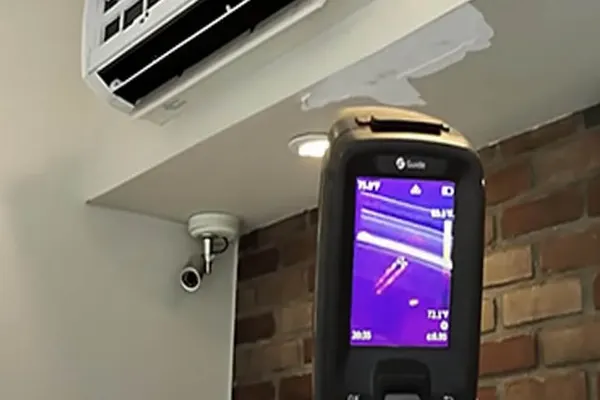
Improper duct sizing or leaky flex junctions can result in 30% of your conditioned air leaking into unconditioned attics. Our licensed field technicians employ hot-wire anemometers, digital manometers, and thermal imaging cameras to verify airflow CFM delivery across every register.
Frequently Asked Questions About Duct Sizing
The right duct size depends on airflow, target velocity, duct shape, and material. For standard residential bedrooms at 700 FPM velocity, 100 CFM requires a 5-inch round duct, 200 CFM needs a 7-inch duct, and 400 CFM requires a 9-inch to 10-inch duct.
Across standard 600 to 900 FPM velocity targets: a 6-inch round duct carries 118 to 177 CFM; an 8-inch duct handles 209 to 314 CFM; and a 10-inch duct accommodates 327 to 491 CFM.
Return air ducts must carry the exact same total CFM as the supply system but are designed at lower velocity (typically 400-600 FPM) to minimize fan motor static pressure and eliminate register whistling.
Round duct is superior for fluid dynamics because circular cross-sections eliminate corner turbulence and carry 15-25% lower friction loss. Rectangular duct is primarily used where joist cavities or low ceiling clearance make round duct impractical.